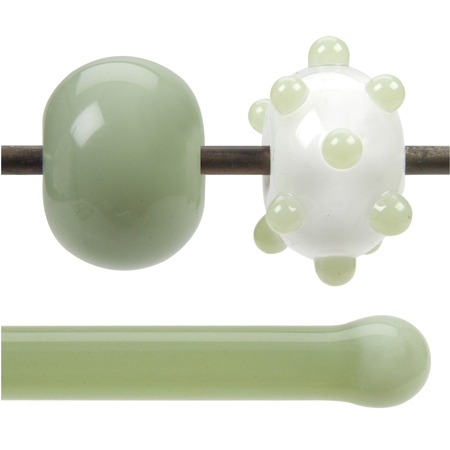
Celadon Green Opal 90 COE Rod (sold per pound; 1/4 pound minimum)
BE R 0207 76 | In Stock | Bin Location: T310-C16
Sale Unit: Pound
Price Code: RB
$35.46Additional Information
Pound and 1/4 Pound Minimum Items
Items labeled in this manner are sold by weight at a price per pound. The price you see is the pound price. You will be charged for the actual weight of the product you receive. If you wish to order a specific number of rods, tubes, sticks or the like, enter that information in the comment box upon checkout. We will do our best to accommodate you knowing how many pounds you want (from the shopping cart) along with how many tubes/items you want from the comment box.
 Bullseye Rods
GRADES
T grade rods are formulated for flameworking and are not recommended for kilnforming. They include Lustres, Opaques, and other styles.
F grade rods can be used for both flameworking and kilnforming. They are part of the Bullseye Compatible product line.
F and T grades may be combined reliably in the torch.
KILNFORMING WITH F GRADE RODS
The material characteristics of F grade rods relate closely to the Bullseye sheet glass palette, with some noteworthy differences, generally driven by the rod-forming process and the nature of the form itself. Comparisons to 3mm sheet glass are drawn here.
Transparents
It is important to consider how color saturation relates to volume and thickness of form. The diameter of a rod is greater than the thickness of standard 3mm sheet and displays more saturated color. Many styles are highly saturated and will reveal lighter coloration if used in small amounts, displaced and thinned through kilnforming methods, or ultimately coldworked to remove material. Conversely, the BE 1800 series has subtle coloration and much greater transparency, which is suitable for working thicker or as visual representation of negative space in thinner works. For medium color saturation, the BE 1500 series (currently unique to rod) has less color saturation and more transparency than its BE 1400 counterpart. As a general guideline, color saturation decreases as the style number increases. Striking transparent pinks and purples likely contain a linear streaked design along the length of the rod, which may also be visible if fired on end. Linear streaking is most prevalent in the following glasses: BE 1215, BE 1232, BE 1305 and BE 1311. Hue and saturation may also differ slightly when compared to sheet glass; a wider range is accepted due to changes that occur in the forming process.
Opalescents
Expect more variation in opalescent rods when compared to sheet glass, with several styles taking on both greater opacity and lighter coloration. This visible shift occurs in sulfur glasses during the forming process and remains stable through kilnforming. Similar comparisons in color and opacity could also be drawn between sheet glass and stringer. (See www.bullseyeglass.com/torchtips for more information about sulfur content.)
When viewed on end, opalescent rods may exhibit a small dark spot—a core that runs the length of the rod. Whether it is a darker version of the rod color or transparent in nature, it generally remains stable through firings and can be used as a design element. This too, is a result of the forming process.
HOW IS BULLSEYE ROD GRADED?
“F” rod is recommended for kilnwork or torchwork. The majority of rods are "F."
“T” rod is recommended for torchwork only.
The “F” and “T” grades were created to help kilnworkers who want to incorporate rods in fused work. The grades are essentially irrelevant for torchworkers, since all Bullseye rods are recommended for torchwork.
 Bullseye Glass Company
Bullseye Glass Company is a manufacturer of colored glass for art and architecture with worldwide distribution and a strong commitment to research, education, and promoting glass art. Bullseye Glass was started in 1974 and is based in Portland, Oregon.
Fusible glasses manufactured by Bullseye are factory-tested for compatibility with each other and are labeled Bullseye Compatible.
We stock Bullseye’s Double Rolled (30) sheets which have a flatter surface than single-rolled sheets and are ideal for fusing. Thin Rolled (50) are half the thickness of standard glass (1.6 mm) and exceptionally easy to cut.
Ordering Information:
Bullseye Glass is priced by the pound. Average weight of a double rolled (3 mm) sheet is 8 pounds (3.7kg) per sheet. Thick-rolled (6 mm or 1/4") is 16 pounds (7kg) per sheet. Thin Rolled are half the thickness and average weight is 2.5 pounds (1 KG) per sheet. Tekta is sold by the square foot.
Bullseye glass bears a 4-digit base code and a 2-digit suffix. In addition, some include a final letter code. The first four digits indicate the base glass; the second two digits indicate surface treatment, profile or thickness.
| 4-Digit Base Code 0XXX Solid Opal 1XXX Solid Color Transparent 2XXX 2-Color Streaky 3XXX 3-Color Streaky 4XXX Collage Glass 6XXX Ring Mottle Letter Code F Fusible/Tested Compatible 2-Digit Suffix Code 21 Ripple 22 Herringbone Ripple 24 Soft Ripple 25 Iridized Herringbone Ripple 30 Double Rolled (3mm) 31 Rainbow Iridized Double Rolled 33 Double Rolled, 40" long |
37 Silver Iridized Double Rolled 38 Gold Iridized Double Rolled 43 Reed texture (3 mm) 44 Iridized Reed 45 Accordion texture (3 mm) 46 Iridized Accordion 50 Thin Rolled (1.6 mm) 51 Rainbow Iridized Thin Rolled 53 Reed Thin Rolled 54 Iridized Reed Thin Rolled 55 Accordion Thin Rolled 56 Iridized Accordion Thin Rolled 57 Silver Iridized Thin Rolled 58 Gold Iridized Thin Rolled 60 Thick Rolled (6 mm) 80 Double Rolled (4 mm) 81 Iridized Double Rolled (4 mm) |
Experimental Bullseye sheets are not run on a standard schedule from the manufacturer and therefore have a limited availability.
Bullseye also manufactures frit, powder, confetti, billets, rods, stix and stringer in three thicknesses - 1mm, 2mm and 0.5mm.

Similar Items Based on Groupings
Area of Interest:
Coefficient (COE):
Color:
Glass Product:
Glass Style: